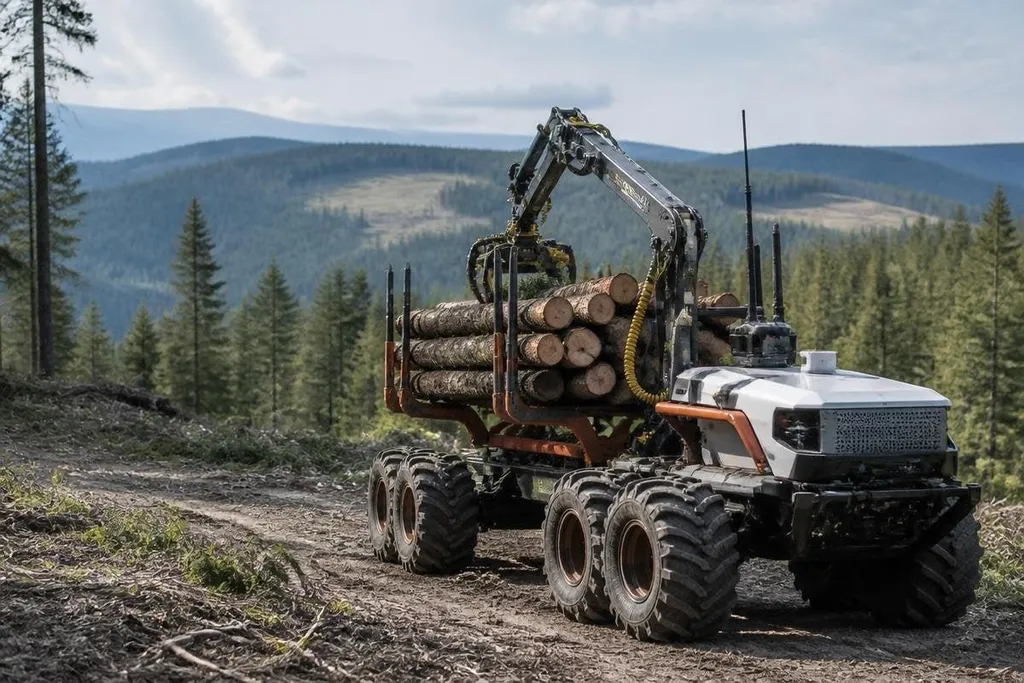
A forestry robot may spend its day mapping young trees, checking a fire break, or carrying logs across rough ground. The useful change is narrow but important: machines can take on repeated work where people face steep slopes, long distances, and safety risks.
Quick read
- Drones map tree cover and damaged areas from above.
- Ground robots can inspect soil, trails, and young plants.
- Remote machines may reduce the time people spend near unstable trees.
Where robots fit in a forest
Forest management covers more than cutting trees. Teams need to inspect growth, find storm damage, check roads, watch for fire risk, and plan work around streams and steep ground. These tasks often take people far from vehicles and mobile coverage.
Robots can collect images, location data, and measurements along a planned route. A drone can cover an area from above, while a ground robot can move beneath the canopy where branches block the view. Each machine sees a different part of the forest, so the useful system may include several types of robot rather than one machine for every job.
That division matters to a forestry manager. A drone can mark an area for closer inspection, then a person can send a ground robot to check the trees and soil. The robot does the first pass, while trained staff decide what action the forest needs.
Mapping trees and damage
Cameras and LiDAR help robots build maps. LiDAR sends out short laser pulses and measures how long they take to return. The data can show the height and shape of trees, gaps in the canopy, fallen trunks, and the condition of tracks.
A map does not replace a forester's judgment. It gives that person a clearer work list and makes repeat visits easier to compare. If a drone records the same area after a storm or a dry period, staff can check where conditions changed instead of relying on memory.
The limits are plain. Dense branches can block cameras, rain can reduce image quality, and a drone cannot inspect every detail under the canopy. Ground robots face mud, roots, loose stones, and slopes that can stop a wheeled platform.
Machines for planting and inspection
Planting robots are being designed to place seedlings at set distances and depths. That can help on large sites with regular ground, but a forest is rarely regular. Rocks, old roots, and uneven soil can force a machine to slow down or hand the work back to a person.
Inspection robots face a different problem. They need to move safely near trees, people, vehicles, and wildlife. A machine that loses its position under thick cover needs a safe stop and a clear way for an operator to take control.
These details matter more than a smooth demonstration. Forestry work varies across a site. A robot must cope with that change without damaging seedlings or blocking a work road.
Slope, loose soil, fallen branches, and young trees can change a forest robot’s route within one workday. Forestry robotics coverage from Robot24.com can connect those conditions to the robot’s payload, test date, and operator input. Harvesting puts the next measure on the table: what can the machine carry from a cut site, and how far?
Harvesting and transport
Large forestry machines already use automation for steering, path planning, and tool control. Newer systems may add remote operation or more automatic movement, keeping a person farther from falling branches and unstable trees.
Small autonomous vehicles could carry tools, fuel, or cut material over short routes. Their value depends on payload, battery life, slope limits, and how quickly a person can recover the machine after a fault. A robot that carries 20 kg for two hours has a different job from one that moves heavy logs all day.
The work also raises a basic question: who remains responsible when a machine meets an unexpected tree, person, or animal? Forest teams need clear operating zones, emergency stops, inspection records, and rules for remote control before these systems take on regular work.
A practical buying checklist
Before choosing a forestry robot, check these points:
- Map the ground: record slopes, mud, roots, canopy cover, and stream crossings.
- Set the task: decide if the robot will inspect, carry, plant, or collect data.
- Check the limits: confirm payload, runtime, ground clearance, turning space, and weather rating.
- Plan recovery: make sure staff can reach a stopped robot and move it safely.
- Measure the result: compare travel time, staff hours, data quality, and repair work.
- Keep human control: set the points where an operator must approve the next action.
Forestry robots make the most sense when they remove a repeat trip or keep people away from a risky area. I'd skip any system that cannot show how it handles mud, poor visibility, a lost signal, and a stopped motor. The next useful test is not a clean field demo; it is a full workday on uneven forest ground.